
The $30m "Failure"
Why Seedstrapping and Venture Capital Don’t Go Together

👋 Hi, it’s Zdenko, and welcome to 215 new readers since last edition.
Seedstrapped is a newsletter about funding and building profitably growing SaaS businesses in the age of AI.
If you’re new here, start with some of the most-read issues:
Seedstrapping: The Smarter Way to Fund Your Startup in 2025?
Seedstrapping Success Stories: From $500k Raises to 8-Figure Exits
7 Underrated Cold Outreach Tactics for Seedstrapped Founders
Earlier this week, I shared a breakdown of VC math on LinkedIn, and it sparked a massive debate. The post went viral with over 170,000 impressions and hundreds of comments.
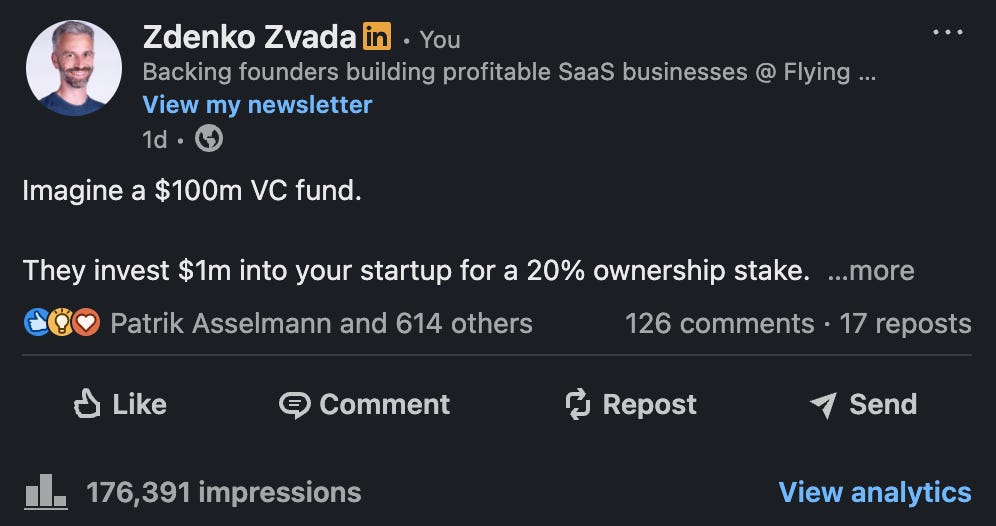
Why? Because it touched on a painful truth: A "dream exit" for a founder can be a "failure" for their investor.
Many founders treat a Venture Capital (VC) check like a trophy. They believe that if a top-tier firm invests, it proves their business is "good." And vice versa, if no VC wants to invest, that their business sucks.
The truth is that if a VC invests in your business, it means only one thing: they think you’re a good fit for their business model. Not necessarily that you have a "healthy" business.
This is the main challenge for “seedstrapped” founders. Seedstrapping - taking a small amount of initial capital to reach profitability and then intentionally stopping the fundraising cycle - is a smart way to build a durable company. But it is fundamentally at odds with how VC funds operate.
To understand why, you have to understand the Power Law.
First, what’s a VC Fund, really?
A VC fund is not just a pool of “rich people’s money.” It is a professional vehicle where “General Partners” (GPs) manage money for their investors, so-called “Limited Partners” (LPs) - think pension funds, university endowments, family offices, funds of funds and of course also rich people (or high-net-worth-individuals if you like).
The LPs expect the VC fund to perform significantly better than the stock market to justify the high risk. As a rule of thumb, a VC fund needs to return 3x+ times the total fund size over 10 years to be considered a success. That's the bar. Anything below it, and the GPs might not raise their next fund.
So if a VC manages a $100m fund, they must return $300m+ to their LPs
A typical seed VC fund will invest in 20 to 30 startups
Why “Good” is not Enough
In most industries, performance follows a “bell curve,” where most people are average and a few are outliers. Venture capital follows the Power Law, which is much more extreme.
In a typical VC the math breaks down roughly like this:
70%-80% companies will fail or barely return the original investment (0x - 1x return)
15%-25% will be average (2x to 5x return)
1-2% will be the “Fund Returner” (100x+ return)
For the fund to reach its $300m goal, those few “Fund Returners” must pay for every single failure and provide the entire profit.
This means the VC isn’t looking for “good” businesses; they are looking for outliers that can grow 100x or 1,000x.
The $30m “failure”
Let’s look at how a successful seedstrapped exit can be a technical failure for a VC fund.
Imagine a VC with a $100m fund. They invest $1m into your startup for a 20% ownership stake. You use that money wisely, hit profitability and decide you don’t need to raise more money. Ten years later, you sell your business for $30m.
For you, the founder, this is a life-changing triumph. You still own 80% of the company and walk away with $24m.
But here is the VC’s ledger:
Company Sale Price: $30m
VC Ownership: 20%
Cash returned to VC: $6m
VC Goal: $300m
Progress toward goal: 2%
Two percent. From a $30m exit.
Even though you built a healthy business, your success only moved the needle by 2%. From the VC’s perspective, the time and space you took in their portfolio was “wasted” because you didn’t have the potential to return the entire $300m.
But wait, isn’t 6x a good return?
I saw this comment few times under the post.
$6m is still better than zero.
Technically, yes. But in the power law game, they are functionally similar.
Don’t get me wrong, if a VC invests in a “potential unicorn” and it “fails” into a $30m exit, they will happily take the $6m check.
But try walking into their office and pitch a plan to exit for $30m. They will show you the door. Why?
Because VC math relies on the winners returning 100x to pay for the losers. By saying that $30m is a great exit for you that you are aiming for, you are telling them: “I am offering you all the risk of a startup, but I have removed the possibility of the 100x home run.”
As one of the commenters mentioned:
It’s far more likely that VCs will pass on your company in favor of one with a chance at $1bn.
See also accidental vs. intentional seedstrapping that I wrote about in the previous edition.
The Portfolio Game vs. The Life Game
This leads to the fundamental misalignment between founders and VCs that many founders don’t realise until they raise funds from VCs.
This comment summarised it nicely:
VCs are playing a portfolio game where 90% of companies can die as long as one hits. Founders are playing a life game where they have one company and a few shots max.
This is why VCs push founders to “grow at all costs”. They would rather you take a 90% risk of going bankrupt trying to become a $1bn “unicorn” than settle for a 90% chance of becoming a $30m success.
In the VC model, a $30m exit and a $0 exit look almost exactly the same.
Better Partners for your Seedstrapped Journey
So if the maths forces traditional VCs to ignore seedstrapped businesses, where should you go for that initial “seed”?
Your best shot are investors who are not managing someone else’s money, and instead investing their own funds. Or, investors whose business models aren’t tied to the Power Law.
As shared in some of my previous editions, these could be coming from these 3 groups:
Angels & operators (often ex-founders) - Individuals who’ve built and exited companies themselves and now back others taking a similar path. They know what a $30m exit actually feels like because they’ve lived it.
Micro / alternative funds - smaller, nimble funds (often <$50m) that write early checks, move fast, can stay hands-on and for whom 5x to 10x return is a celebrated win, not a rounding error.
Family offices - patient capital with more flexibility than institutional VC. Many family offices invest more and more in early-stage companies, preferring sustainable growth and dividends over forced exits.
There’s no good database of seedstrap-friendly investors (yet).
Last year I created a list of seedstrap-friendly investors. I am now updating it with new names. If there is anyone you’d like to add on that list, just hit reply to this email.
And, if you have any further comments/questions on the VC vs. seedstrapping just add them in the comments below.
Thanks!
Zdenko
PS: If you’re building with a seedstrapping mindset or exploring this option, let’s connect. We’re looking to invest $100k–$500k in 1–2 companies this quarter with Flying Founders.
portfolio game vs life game is a good way to put it
I think there will be more and more of the micro sized funds to help these kinds of founders specifically in a world where it is becoming easier and easier to build a small startup with a handful of people. You don't need a $10M seed round to do it but just a little bit to get the ball rolling!