
Score 6/10 on these to Hit PMF in 2026
A practical PMF signal checklist for bootstrapped founders (no VCs allowed).


👋 Hi, it’s Zdenko, and welcome to Seedstrapped, a newsletter about funding and building profitably growing SaaS businesses in the age of AI.
If you’re new here, start with some of the most-read issues:
Seedstrapping: The Smarter Way to Fund Your Startup in 2025?
Seedstrapping Success Stories: From $500k Raises to 8-Figure Exits
If you’re building with the “raise once and done” mindset, product-market fit (PMF) and go-to-market (GTM) are the only two things that matters. It is what converts that initial capital into momentum. If that motion is broken, your first raise is a countdown. If it’s fixed, that raise is the last money you’ll ever need to take.
The most successful founders I know didn’t find success by accident. They found it by being ruthlessly selective about their audience and their acquisition channels. That focus is what turns a lean budget into an unstoppable engine.
That’s why I’m excited about today’s guest post by Majd Alaily.
Majd is a founder and builder who obsesses over the “truth” in data. He’s seen too many founders mistake “polite feedback” for “product-market fit,” leading them to scale a leaky bucket. In this edition, Majd breaks down his Score 6/10 framework: a 10-point checklist designed specifically for boot/seedstrapped founders to stop lying to themselves and start measuring what matters.
In this post, Majd walks us through the 10 cold, hard signals that prove you’ve actually hit PMF in 2026 - and why scoring a 6/10 is the green light you’ve been waiting for.
Enjoy!

A few months ago, I sat across a bootstrapped founder convinced he had product-market fit.
He’d been at it for months.
No funding, just a product he built from the ground up that definitely hit PMF for him.
He kept repeating how much his clients loved the product.
But there was one big problem.
Revenue was flat.
When I say flat, I mean it hadn’t moved in months.
If this makes no sense to you, you’re right. It doesn’t.
But I’ve seen this a dozen times. Founders feel like PMF is close, they get great feedback, the demos go well, but… the numbers don’t follow.
And usually, they aren’t lying to me. They are lying to themselves.
PMF isn’t a feeling. It’s a set of signals.
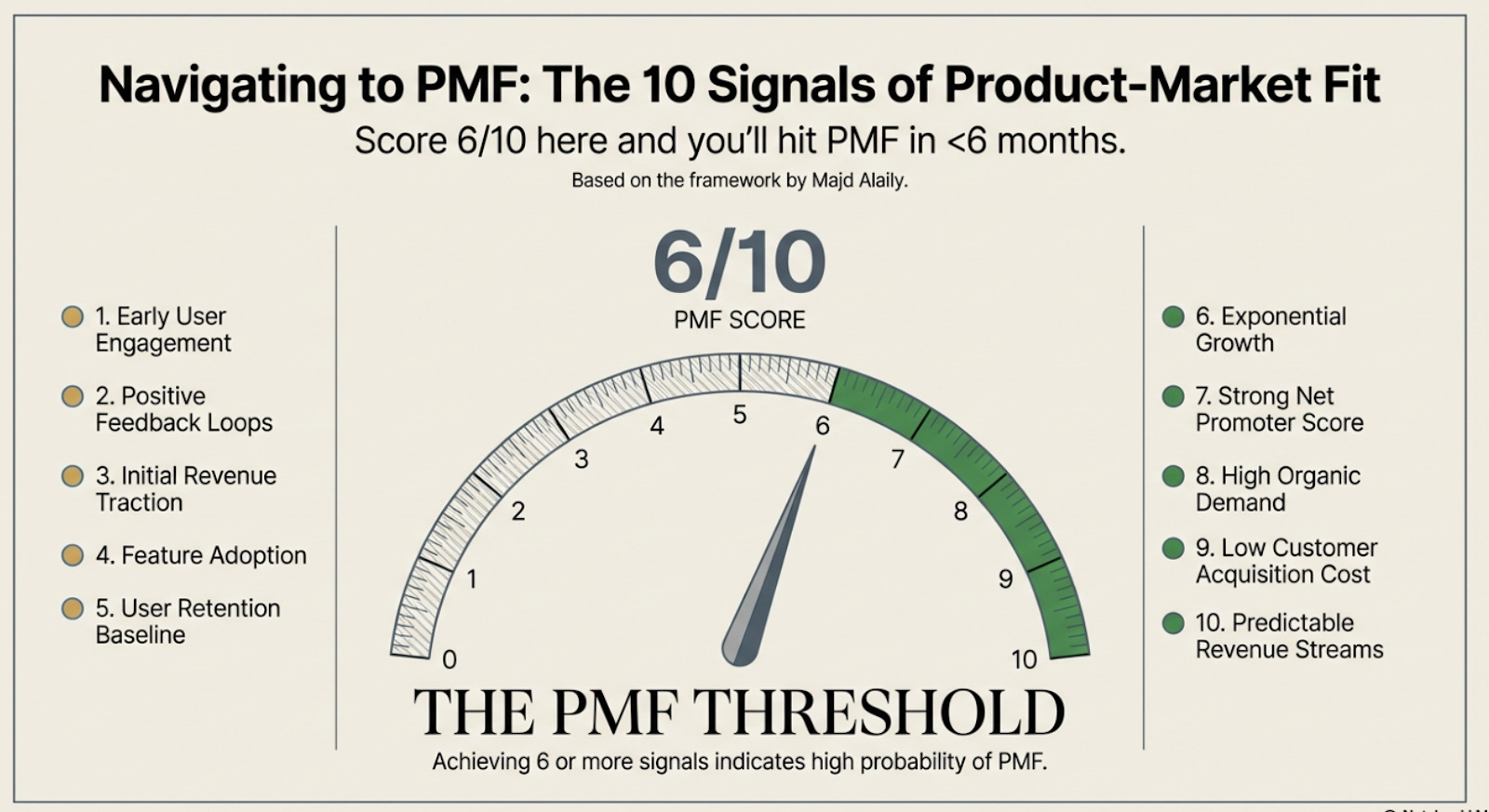
And if you’re bootstrapped, running lean, without institutional investment to back you up, reading those signals correctly makes all the difference.
Between grinding in the wrong direction and finding the engine that actually runs itself.
And when I say it’s a set of signals. It’s 10 signals specifically.
Go through them, and score yourself honestly. Are you at six out of ten? You’re closer to PMF than you think.
(Let me know then so I can invest early. Wink wink)
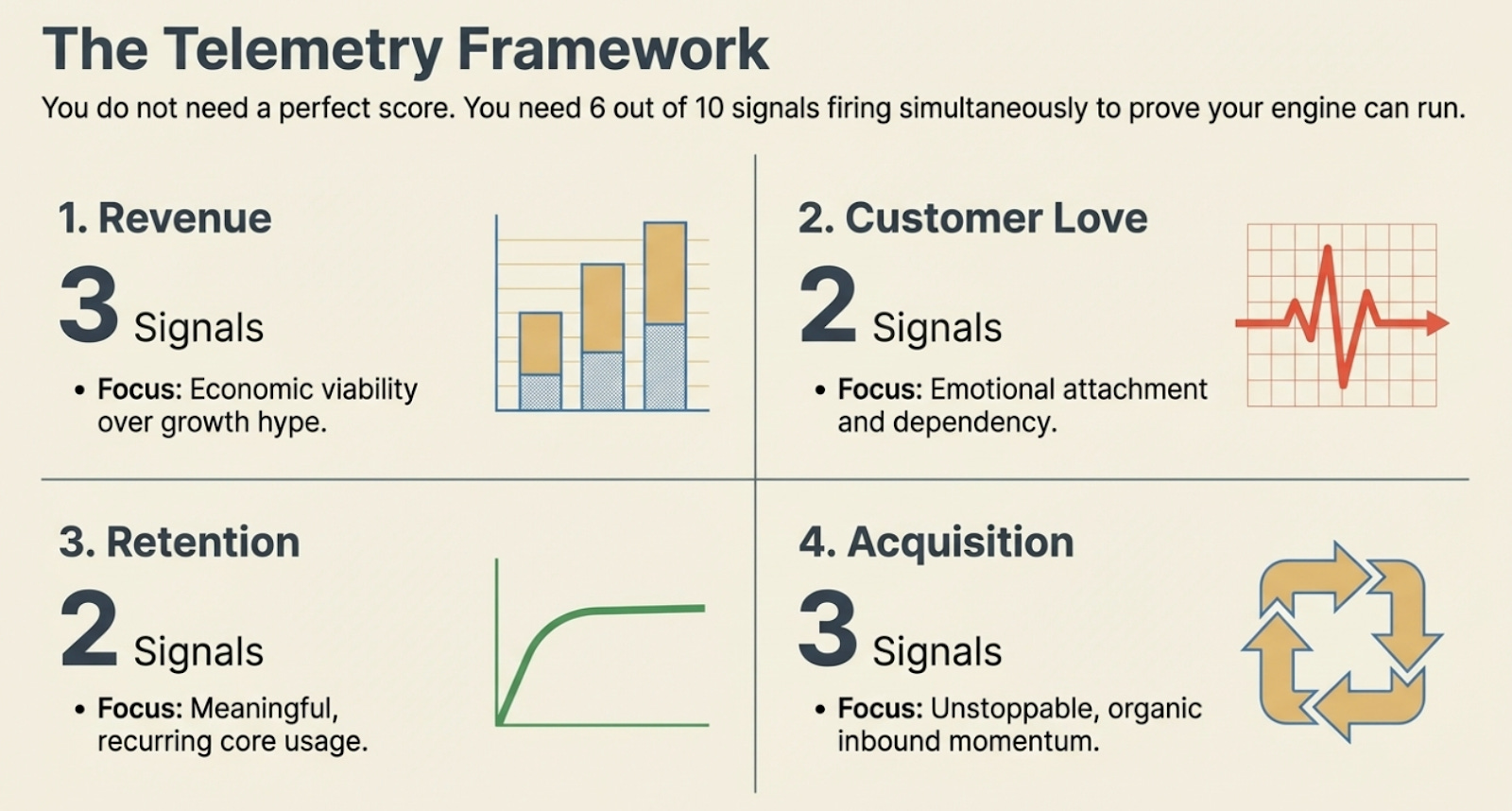
First: Revenue Signals
Signal 1: LTV to CAC Above 3:1
Here you’re measuring how much money your customer brings you in their lifetime (LTV) vs. the cost to acquire them (CAC).
For a bootstrapped founder, this ratio is everything.
You’re not burning investor money to acquire customers, you’re spending your own. So every customer you bring in needs to be worth it.
Customer lifetime value at least 3x the cost to acquire them is the benchmark most operators use.
It means every dollar you spend on acquisition generates three back. That’s economic viability right there.
HubSpot built this ratio early by investing in content-driven acquisition, keeping costs low while value accrued over time. You don’t need their scale to apply the same logic.
How to check this:
Estimate average revenue per customer over their lifetime with you.
Factor in gross margin.
Multiply to get LTV.
Calculate your blended acquisition cost across channels.
Divide LTV by CAC.
If the ratio is weak, fix the economics before you scale anything.
Bootstrapped founders who ignore this end up exhausted and in the red.
Signal 2: A Lead Client
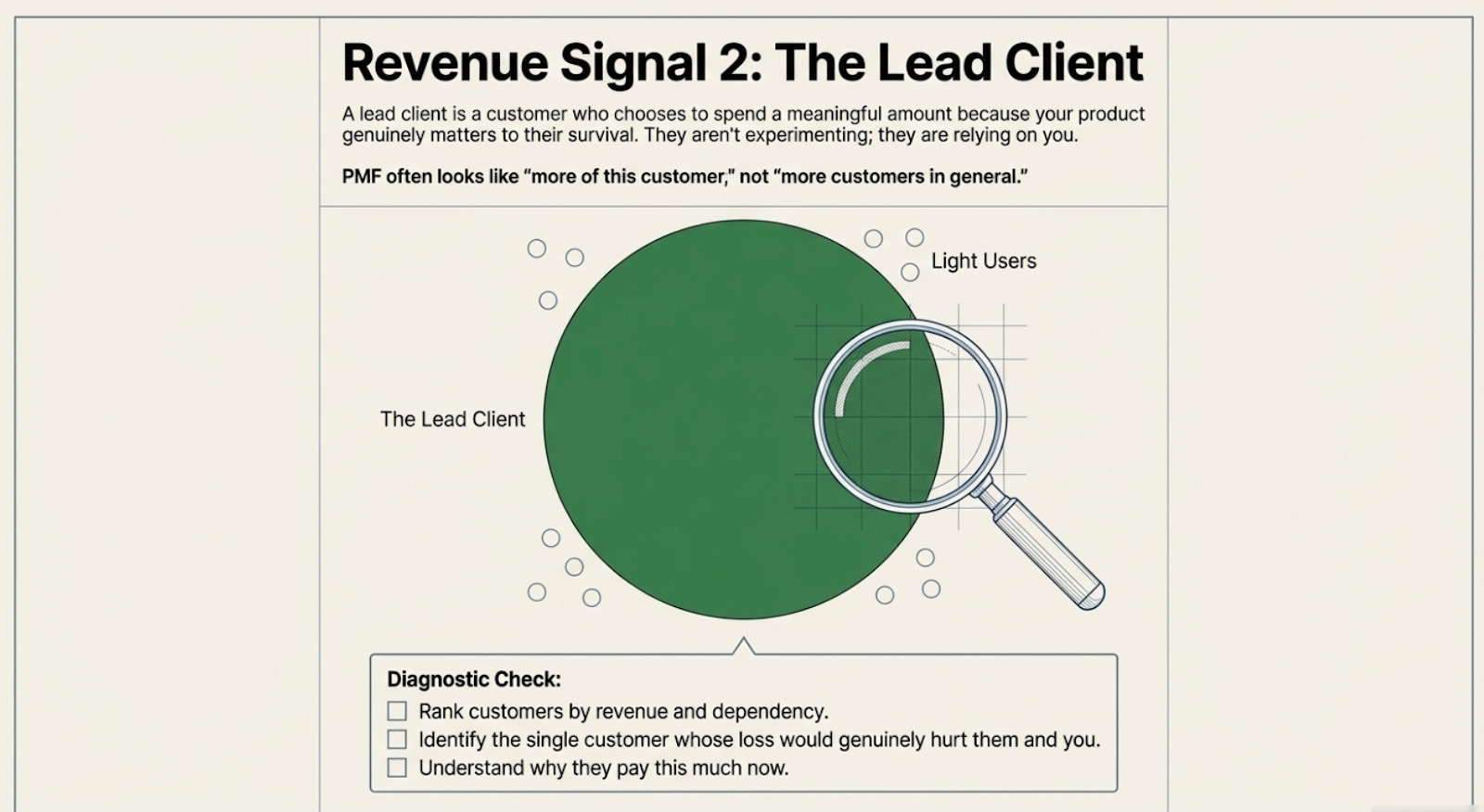
You’ve probably heard the advice to diversify your customer base early.
Ignore it for now. Find one big customer who relies on your product, who would genuinely hurt if you disappeared, tells you more about PMF than twenty casual users.
A lead client isn’t just your biggest contract.
It’s the customer whose behaviour reveals what your product is actually for.
Without VC-backed sales teams, this is your clearest signal.
How to check this:
Rank your customers by revenue and dependency.
Ask yourself: whose loss would genuinely change my numbers this month?
Understand what specific value they’re getting that others aren’t yet.
Use that customer as a lens. PMF often looks like “more of this person,” not more customers in general.
Signal 3: Net Revenue Retention Above 100%
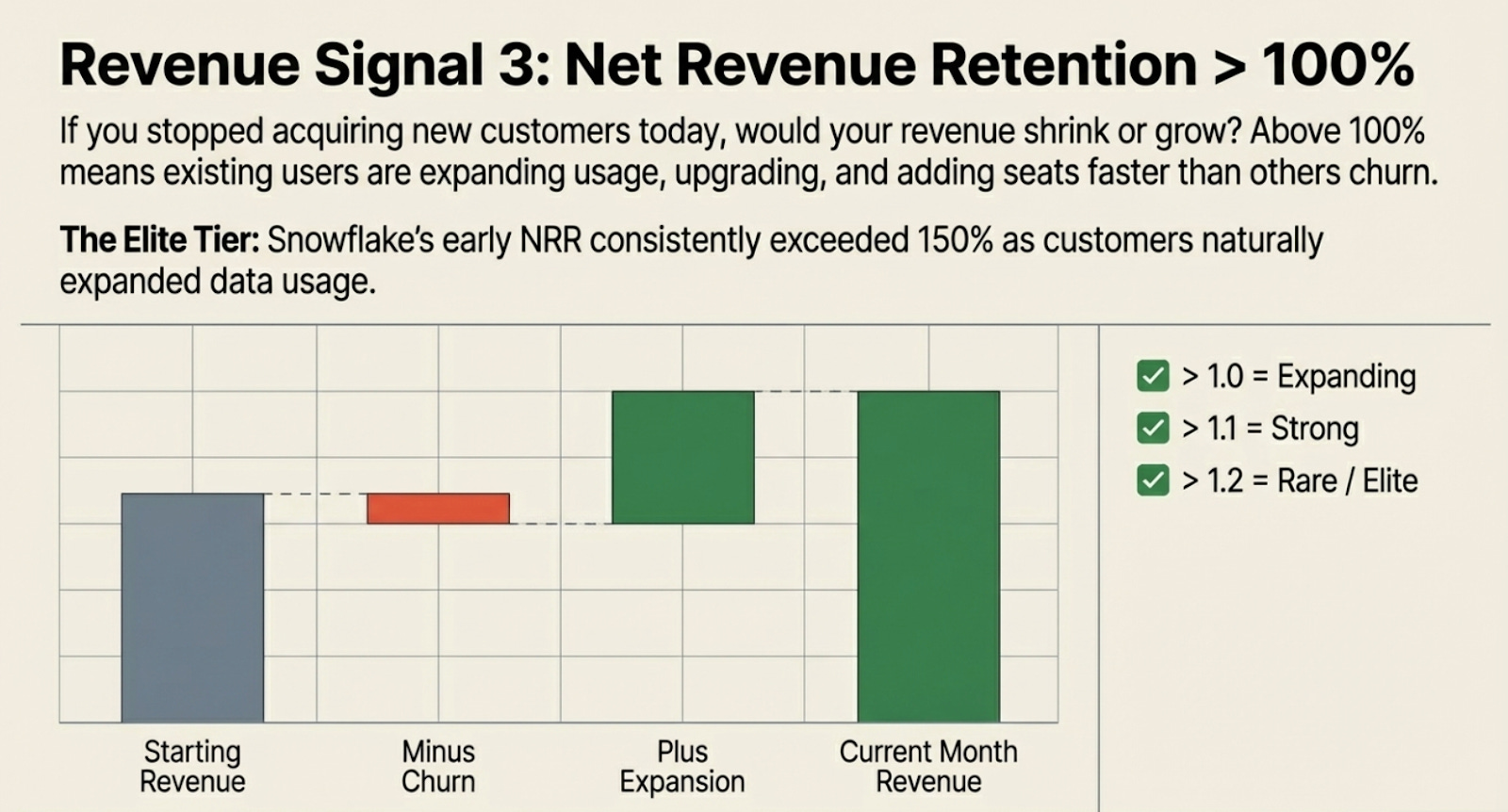
NRR answers one question: if you stopped acquiring new customers today, would your revenue from existing ones grow, shrink, or stay flat?
Above 100% means your existing customers are spending more over time. Upgrades. Expanded usage. Add-ons. You get it.
Snowflake’s NRR exceeded 150% before it was a public company. Customers naturally expanded as their data needs grew.
How to check this:
Take a cohort of customers from a single month.
Calculate what they paid in month one.
Calculate what the same group pays today.
Subtract churned revenue, add expansion revenue.
Divide current by starting.
Above 1.0 means you’re expanding. Above 1.2 is rare. If customers aren’t expanding, ask why before spending more on acquisition.
Second: Customer Love
Signal 4: The PMF Survey
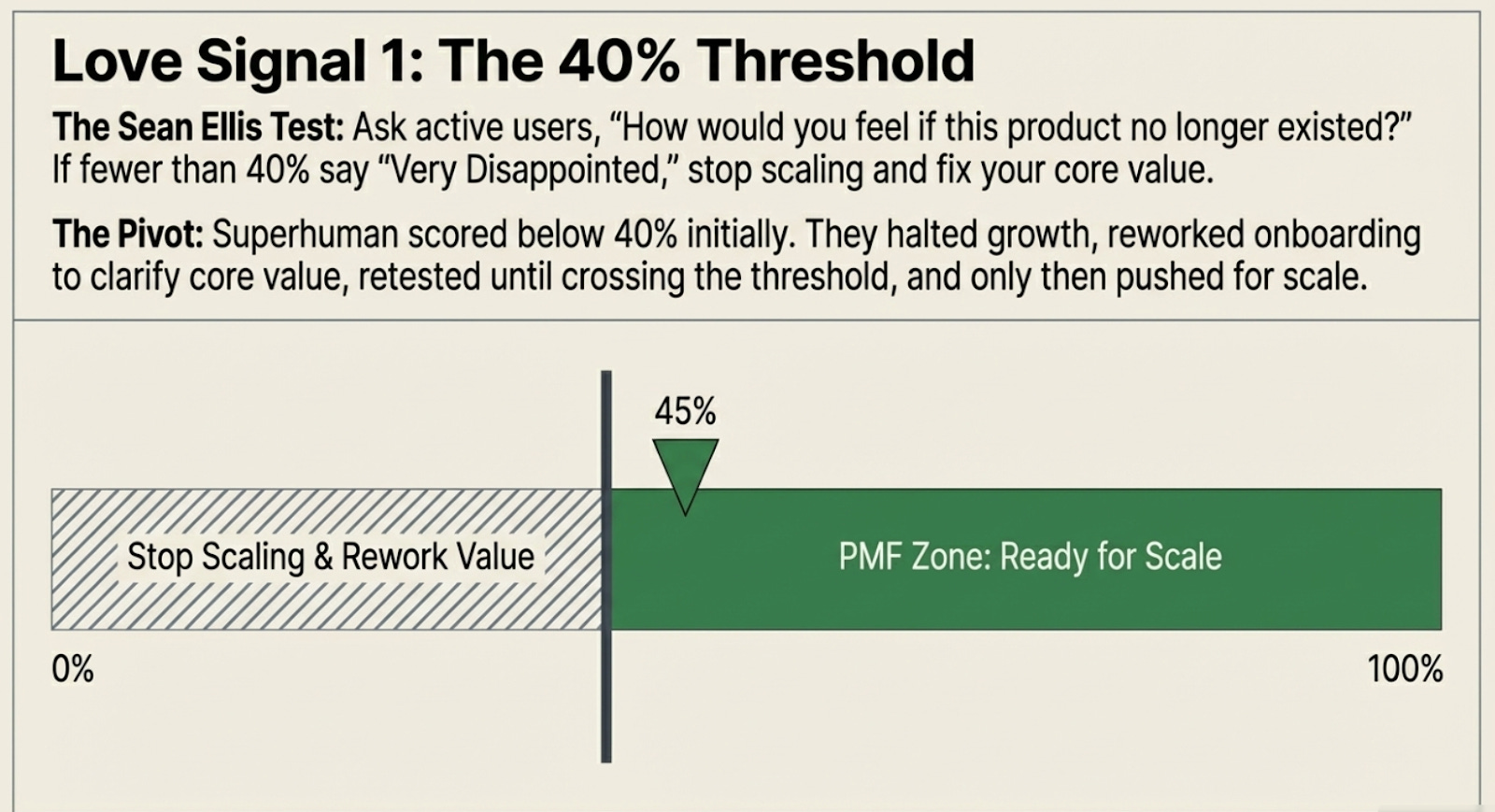
Sean Ellis developed this after working with Dropbox and LogMeIn.
This survey asks one simple question: how would you feel if this product no longer existed?
If 40% or more say “very disappointed,” you’re approaching PMF.
Below 40%, and you need to rework your value proposition before anything else.
Superhuman is the clearest example. When their score came back below 40%, they didn’t scale.
They reworked onboarding, clarified the core value, and retested. Only after crossing the threshold did they push growth.
Getting customer love right matters even more to bootstrapped founders. You can’t afford to pour resources into growing something that isn’t loved yet.
How to check this:
Send the survey only to active users.
Ask the exact question: “How would you feel if this product no longer existed?”
Three options only: very disappointed, somewhat disappointed, not disappointed.
Collect responses anonymously.
Read the qualitative follow-ups. The “why” matters as much as the number.
Signal 5: Complaints When the Product Is Down
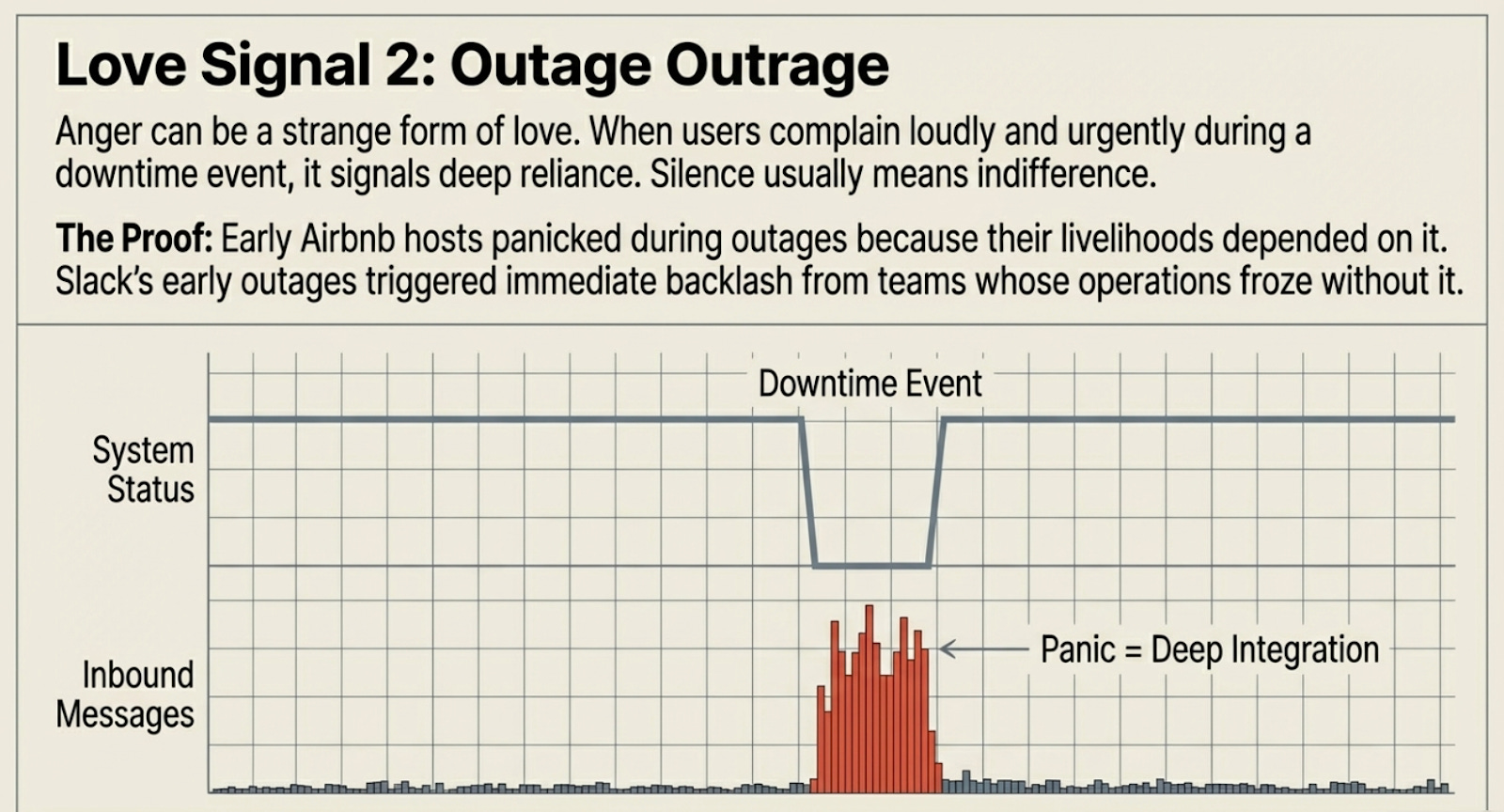
Anger can be a strange form of love.
When users complain loudly during downtime, it means they need the product. They were relying on it. Its absence disrupted something real in their day.
Silence is usually the red flag. Silence usually means indifference.
Brian Chesky has talked about early Airbnb outages where hosts panicked.
Those reactions confirmed how embedded Airbnb had become in their livelihoods.
Slack’s early outages triggered immediate backlash from teams who depended on it for daily communication.
Both of those companies were still small when this happened.
You don’t need scale to get this signal. You need users who actually care.
How to check this:
Track inbound messages during any incident, not just support tickets.
Note the language. Urgency matters.
Compare reactions between power users and casual ones.
Protect the features that trigger the strongest reactions.
Third: Retention
Signal 6: Meaningful Usage
Users come back to the thing that actually helps them.
If your retention is propped up by peripheral features or onboarding sequences, it will fall apart the moment those stop.
Figma’s early team measured collaboration events, not logins. The moment multiple designers edited together, retention jumped. That became the metric they optimized everything around.
For bootstrapped founders, this matters.
You can’t afford to waste development time on features that don’t drive the core behavior. Know what your “meaningful usage moment” is.
How to check this:
Define the single action that delivers your core value.
Track how many users perform it weekly.
Compare retention for users who perform this action vs those who don’t.
Optimize onboarding to drive this behavior early. Everything else is secondary.
Signal 7: A Flattening Retention Curve
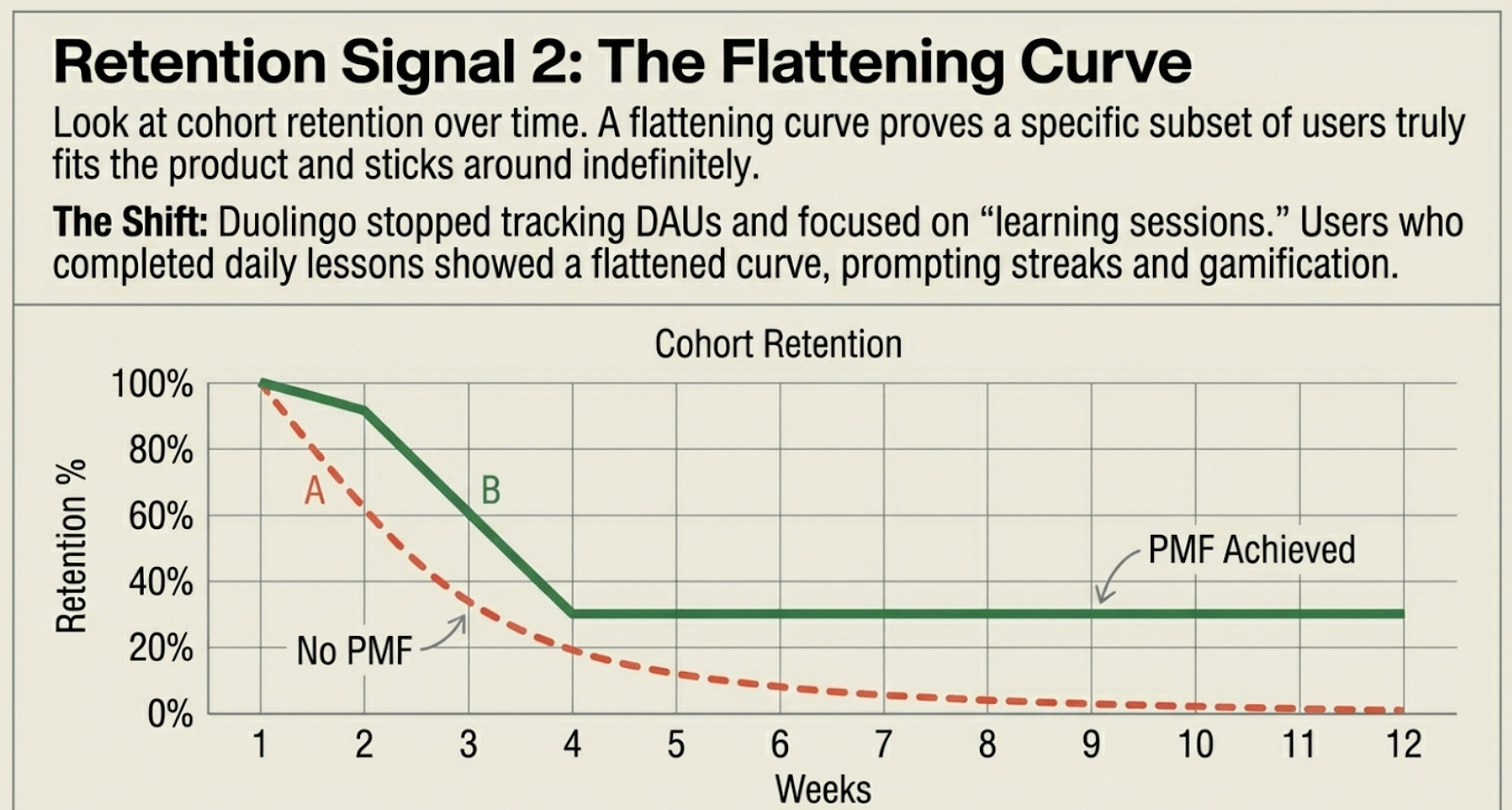
Map your retention curve.
If it drops to zero and keeps falling, you don’t have PMF.
If it starts to flatten, not perfectly, but enough to show a stable base of users who stick, you’re getting there.
Duolingo noticed this before they had massive scale.
Users who completed structured daily lessons had a completely different retention profile. Their curves flattened.
The team doubled down on that behavior, streaks, reminders, gamification. All of it served one purpose: reinforce the thing that was working.
This pattern appears in nearly every growth analysis from firms like a16z, and it’s just as visible on a 200-user dataset as on a 200,000-user one.
How to check this:
Plot cohort retention over time.
Ignore the first few weeks. Focus on months two, three, and four.
Look for cohorts that stabilize instead of dropping to zero.
Study what those users have in common. That’s your real ICP.
Fourth: Acquisition
Signal 8: Non-Trivial Growth
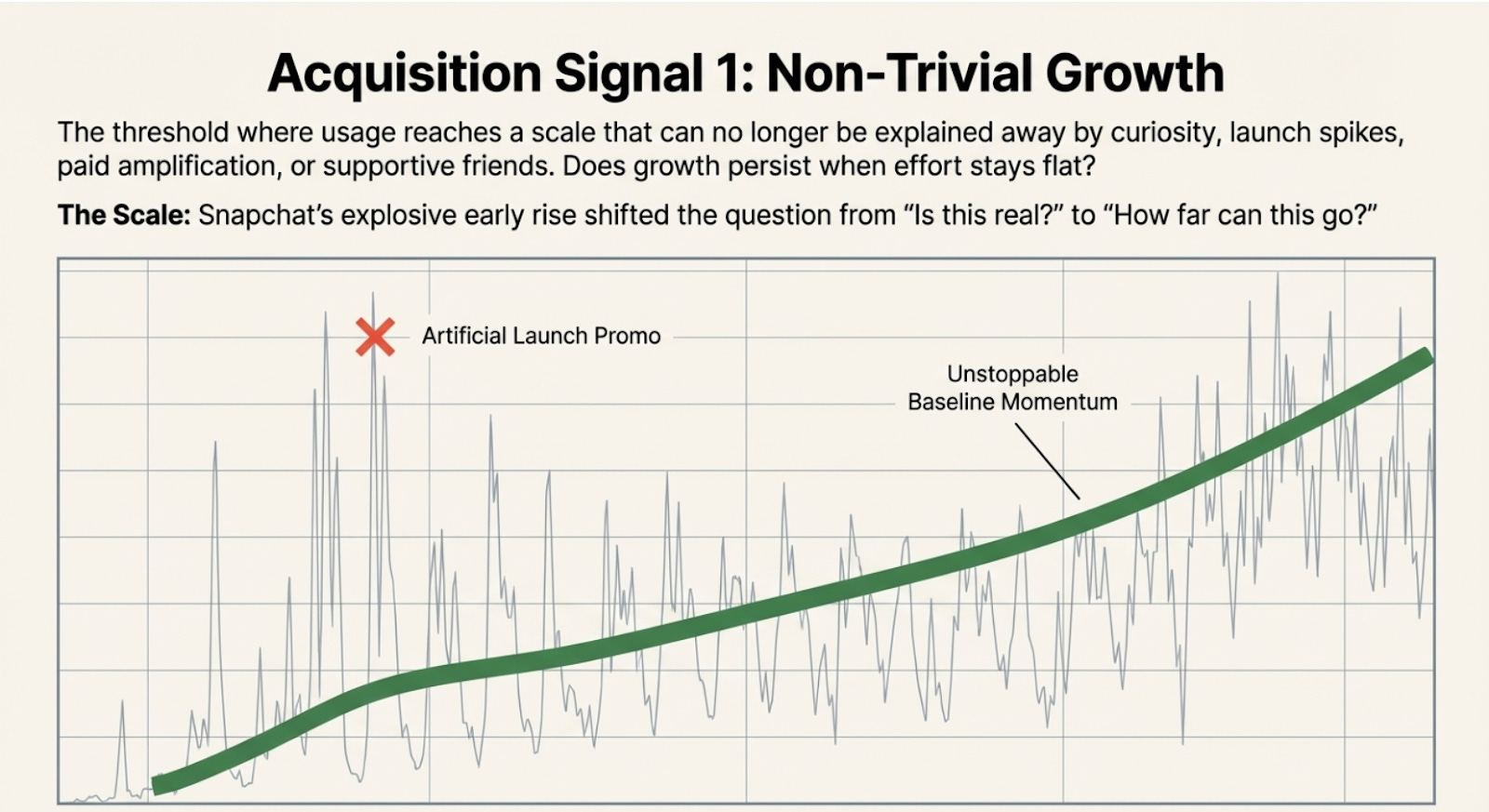
Non-trivial growth doesn’t mean “we’re growing.” It means the level of usage has crossed a threshold where you can no longer explain it away.
Not a launch spike. Not friends being supportive. Not a one-time promo.
Brian Balfour describes this as one of the PMF trifecta signals.
When Snapchat hit hundreds of thousands of downloads, it became undeniable. The question shifted from “is this real?” to “how far can this go?”
For bootstrapped founders, this signal cuts both ways.
Without paid acquisition inflating your numbers, the signal is cleaner. If something is growing, it’s growing because people want it.
How to check this:
Look at usage and revenue together. Growth in one dimension only is fragile.
Remove any obvious artificial lift: launches, one-off deals, personal networks.
Check whether growth persists when your effort stays flat.
Ask honestly: could a skeptic still say “this doesn’t count”? If not, you’re close.
Signal 9: Sales Efficiency
Zoom didn’t win because of a marketing budget.
It won because the product worked so well that users pulled it into their organizations. One person used Zoom. Others joined without friction. Those people started using it themselves.
Many operators describe PMF as the moment sales becomes easier. For a bootstrapped founder without a sales team, this is even more important.
You need the product to do part of the selling.
Signs you’re getting there: sales cycles shorten without you changing anything. Prospects arrive already knowing what they want. Objections decrease. Customers start championing the product internally.
How to check this:
Measure average sales cycle length over time.
Track common objections in calls. Are they getting fewer?
Ask prospects how much research they did before speaking to you.
If cycles shorten naturally, momentum is building.
Signal 10: Organic Inbound
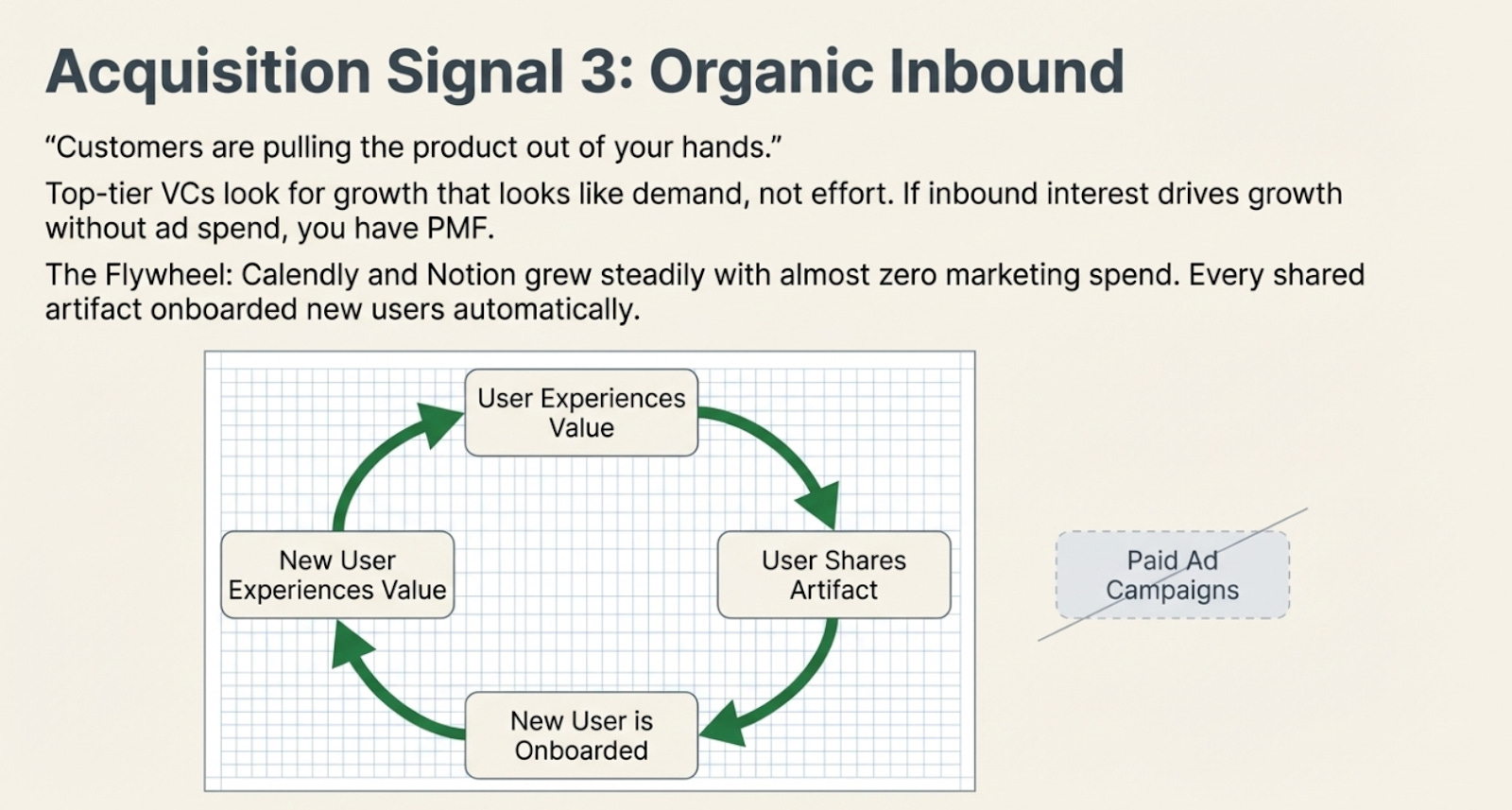
Marc Andreessen described PMF as the moment “customers are pulling the product out of your hands.”
For bootstrapped founders, organic inbound is the clearest version of this you can measure.
Notion grew for years with almost no marketing spend. Users shared templates. Teams adopted it internally. Revenue followed usage.
Calendly grew because every meeting invite was a product demo.
Neither company needed VC to generate these loops.
If a meaningful portion of your new customers arrive through word of mouth, referrals, or inbound interest you didn’t directly generate, that’s real signal.
If inbound is your biggest growth driver? You’re building something totally worth it.
How to check this:
Ask every new user how they found you.
Track referrals separately from any paid or outbound channels.
Measure churn by acquisition source. Organic users almost always stay longer.
Double down on whatever behavior users naturally repeat.
Want to hit PMF in 2026? Work towards these signals. Today.
Remember that product market fit doesn’t live in feelings. It lives in signals. And signals don’t care how hard you worked, how nice your users are, or how good the pitch deck looks.
Signals are clear signs people want and LOVE your product.
Now score yourself.
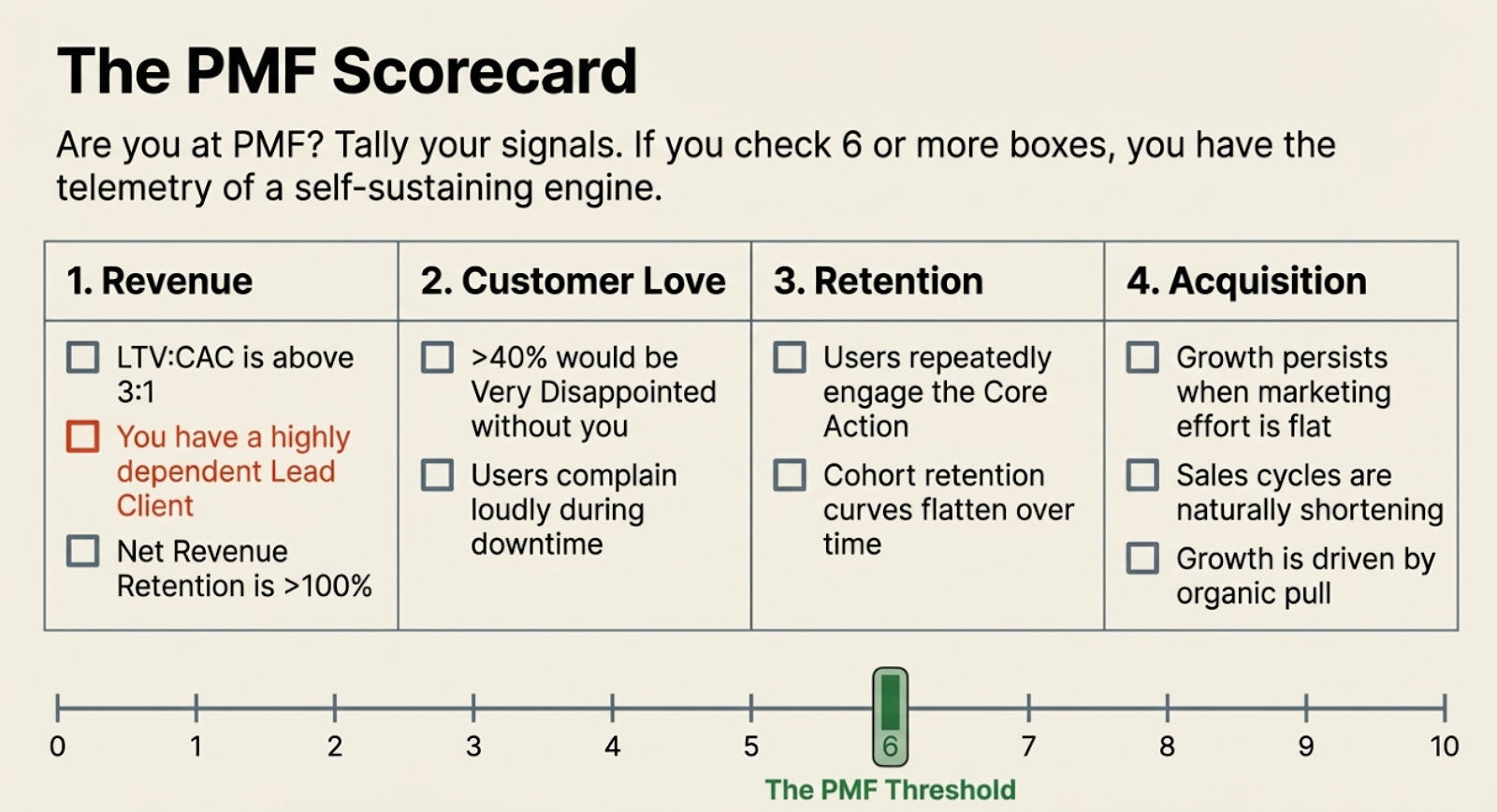
Six out of ten of these showing up? Sweeeeet. (Again let me know ;)
Below six? That’s not failure. That’s data. Pull apart the signals that are missing and work backwards from there.
Honest question: how many of these signals do you hit today? Let me know, I read every response.
See you on the edge,
Majd
 | A guest post by
|
Scoring 6/10 cold signals as the PMF green light — love this framing.
Love this framework - often PMF is talked about in so much abstract terms. Thanks for sharing this.